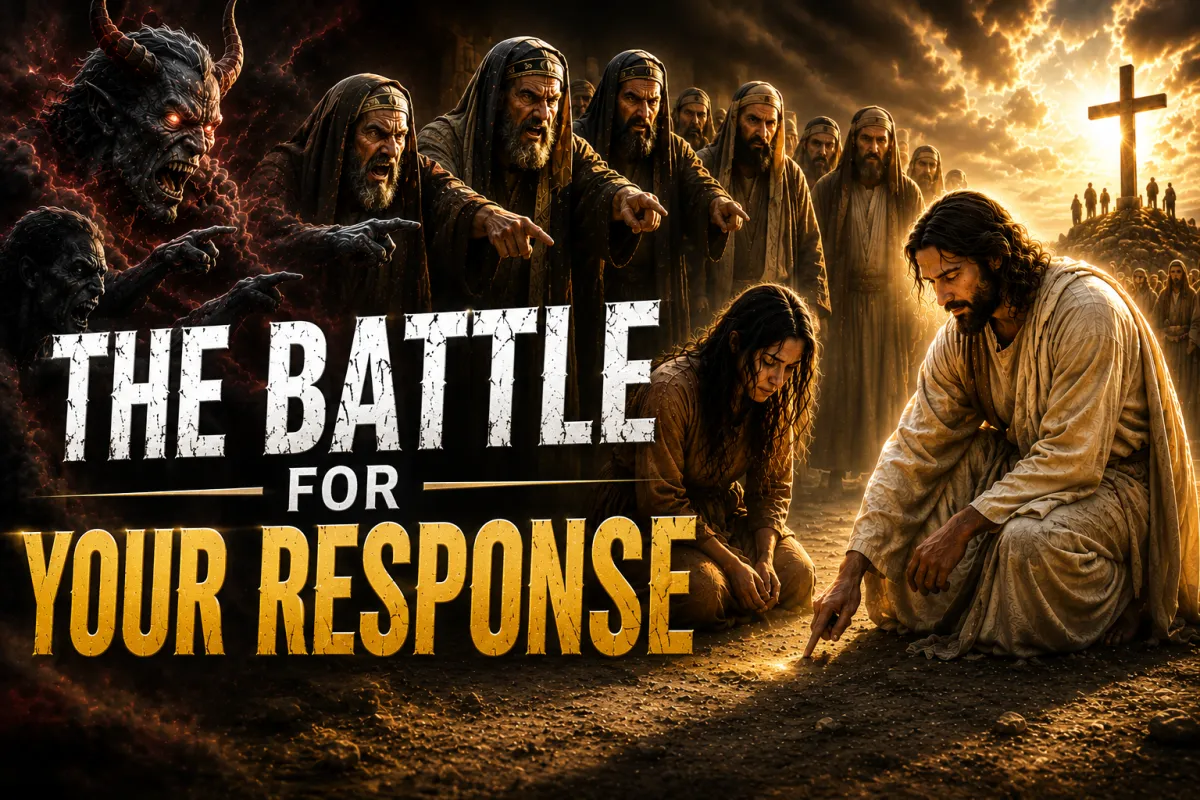
The Battle For Your Response
The Battle for Your Response: Accusation, Mercy, and Redemption
Every day we face a spiritual battle. The enemy seeks to stir up accusation, bring condemnation, and cause destruction. But Jesus calls people into mercy, truth, and redemption. The story of the woman caught in adultery in John chapter 8 gives us a powerful picture of how this battle plays out and what our response should look like.
What Does the Story of the Woman Caught in Adultery Teach Us?
In John 8, the scribes and Pharisees dragged a woman caught in adultery before Jesus. According to the law of Moses, both the man and the woman were to be stoned. Yet only the woman was brought forward. They placed her in front of Jesus and demanded an answer, not out of a desire for justice, but to trap Him.
Jesus stooped down and wrote on the ground. He did not react immediately. He listened. He discerned. And when He finally spoke, He dismantled the entire accusation with one sentence.
The Enemy Often Hides Behind Human Conflict
One of the most important things to understand about spiritual warfare is this: the enemy often hides behind human conflict to accomplish spiritual destruction.
As far back as Genesis 4:7, God warned Cain that sin was crouching at the door, waiting to attack. The enemy is still looking for willing hearts through which he can spread accusation, pride, and eventually destruction.
People may carry the accusation, but darkness is often the driving agenda behind it. In John 8:44, Jesus told the Pharisees directly:"You are of your Father the devil."These were religious leaders. And yet the enemy was using them as instruments of condemnation.
What Is the Difference Between Conviction and Condemnation?
This is a critical distinction that changes how we see ourselves and others.
God convicts to restore. Satan condemns to destroy.
Conviction from the Holy Spirit leads us toward repentance and healing. Condemnation from the enemy is designed to crush, shame, and keep us stuck. The Pharisees wanted judgment. Jesus wanted restoration. The same is true today.
In Revelation 12:10, the enemy is called the accuser of the brethren. Hebrews tells us he accuses us night and day before the Lord. That is exactly what was happening in this passage. The enemy was using the Pharisees to accuse this woman before her Creator.
Not Every Battle Deserves Your Attention, But Every Battle Requires Discernment
Jesus did not immediately engage the Pharisees. He wrote on the ground. He waited. He listened to the Holy Spirit before responding.
Not every battle deserves our attention, but every battle requires our discernment. We do not want to give the enemy a victory by reacting without first seeking wisdom. Ephesians 6:12 reminds us that we do not wrestle against flesh and blood. When we forget that, we end up fighting people instead of the spiritual forces behind the conflict.
Psalm 118:10-17 captures this well:"All nations surrounded me, but in the name of the Lord I will destroy them... I shall not die, but live, and declare the works of the Lord."The battle belongs to the Lord, and He gives us the discernment to navigate it.
How Does Mercy Become a Weapon in Spiritual Warfare?
When Jesus raised Himself up and said,"He who is without sin among you, let Him throw a stone at her first"(John 8:7), something remarkable happened. One by one, beginning with the oldest, the accusers left. The enemy's plan collapsed under the weight of mercy.
The enemy turns people into weapons. The Pharisees were not concerned about the woman. They were using her to trap Jesus. But Jesus saw the image of God beneath her failure. He always does.
2 Corinthians 2:11 says we forgive so that Satan might not outwit us. When we choose mercy, we refuse to cooperate with the kingdom of accusation. Satan weaponizes accusation. Jesus weaponizes mercy.
James 2:13 says:"Mercy triumphs over judgment."While the enemy is busy building cases against us, Jesus is busy canceling our debts.
What Does It Mean That Jesus Cancels the Enemy's Legal Rights?
Colossians 2:13-14 tells us that the record of debt for our sin has been nailed to the cross. The enemy accuses us, but we overcome by the blood of the Lamb and the word of our testimony (Revelation 12:11).
One of the biggest legal rights the enemy uses against us is unforgiveness. When someone wrongs us and we refuse to forgive, we can unknowingly give the enemy a foothold in our lives. That foothold can be canceled through the blood of Jesus and through confession and repentance.
This is why Hebrews 4:16 says:"Let us therefore come boldly to the throne of grace, that we may obtain mercy and find grace to help in time of need."We do not run from God when we fail. We run to Him.
Condemnation Says Hide. Grace Says Come.
Condemnation says hide because you failed. Grace says come because you are loved.
When Jesus was left alone with the woman, He asked her:"Woman, where are those accusers of yours? Has no one condemned you?"She answered,"No one, Lord."And Jesus said,"Neither do I condemn you. Go and sin no more."(John 8:10-11)
That is the heart of God toward us. He does not excuse sin, but He does not condemn us either. He forgives us and sends us forward. Mercy does not excuse our past. It sends us forward, forgiven and free to forgive others.
How Should We Treat Others in the Middle of Spiritual Warfare?
The bride of Christ does not fight people. She fights the spiritual battle by loving like Jesus.
Ephesians 4:15 calls us to speak the truth in love. There is a wrong way to echo truth. You can say the right thing in completely the wrong way. Speaking truth with love is a supernatural ability that grows when we spend time with Jesus. People around us can often tell when we have not been with Him.
Philippians 2:13 says:"It is God who works in you both to will and to do for His good pleasure."It is not our natural strength that enables us to love difficult people. It is God working through us.
Stephen, being stoned to death, cried out:"Lord, do not charge them with this sin."That kind of response only comes from someone who has been with Jesus. Truth without love wounds. Love without truth deceives. Jesus modeled both perfectly, and He calls us to do the same.
What the Enemy and Jesus Each Want You to Remember
The enemy reminds you of your failures. Jesus reminds you of your identity.
The enemy wants to define you by your worst moment. Jesus sees the image of God in you beneath every failure. He confronted sin while restoring the person. He does the same for us today.
Life Application
This week, identify one area of your life where you have been responding to accusation or conflict without discernment. It may be a relationship, a recurring struggle, or a pattern of shame you keep returning to. Instead of reacting or hiding, bring it to the throne of grace. Apply the blood of Jesus to that area through prayer, confession, and if needed, forgiveness of someone who has wronged you.
Ask yourself these questions:
Is there someone in my life I have been treating as an enemy rather than recognizing the spiritual forces behind the conflict?
Is there unforgiveness in my heart that may be giving the enemy a foothold in my life?
Am I running toward God when I fail, or am I hiding from Him out of shame and condemnation?
Am I speaking truth to others in love, or am I using truth as a weapon?
God does not call you to hide. He calls you to come. Run to the throne of grace this week, receive His mercy, and go forward in freedom.
